
Modernizing Banking Onboarding in Dynamics 365 CE with Embedded Canvas Apps
Financial institutions constantly strive to balance regulatory compliance, operational efficiency, and user experience. In Dynamics 365 Customer Engagement (CE), recurring processes such as Know Your Customer (KYC) and credit checks are critical—but often too industry-specific to be fully supported by out-of-the-box functionality.
At Releye, we work closely with banks and financial service providers to design industry-specific extensions for Dynamics 365 CE. In this article, we share a practical, developer-focused approach to implementing KYC and credit check processes by embedding Canvas Apps directly into Model-Driven Forms—creating a seamless experience for users while maintaining a robust, scalable architecture. We feel that there is a lack of documentation on this topic, which is why we’ve written this article.
This guide focuses on:
- Embedding Canvas Apps in Model-Driven Forms Using Form Context
- Using this capability to support banking-specific onboarding processes
- Two use cases: KYC and credit check
PowerApps: How to Embed Canvas Apps in Model-Driven Forms
The Power Platform has evolved rapidly. Today, Model-Driven Apps, Canvas Apps, and Power Pages can be combined to deliver highly customized solutions. One particularly powerful (and sometimes overlooked) feature is embedding a Canvas App within a Model-Driven form.
When implemented correctly, the embedded Canvas app can:
- Access the current record context
- Interact directly with Dataverse
- Trigger automations and integrations
- Provide a guided, task-focused user interface within otherwise structured model-driven forms
For banking scenarios—where guided data capture, validation, and external integrations are common—this combination is particularly valuable.
Embedding a Canvas App with Form Context (Technical Walkthrough)
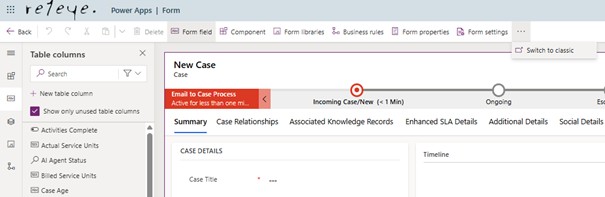
Note: While modern form editors allow you to embed Canvas Apps, they do not automatically enable form context integration. To access the “ModelDrivenFormIntegration component,” you must use the classic form designer as described below.
Step 1: Create the Canvas App.
Create the Canvas App that you want to include on a form in your Model-Driven application. The Canvas App can be created in either a new or existing solution.
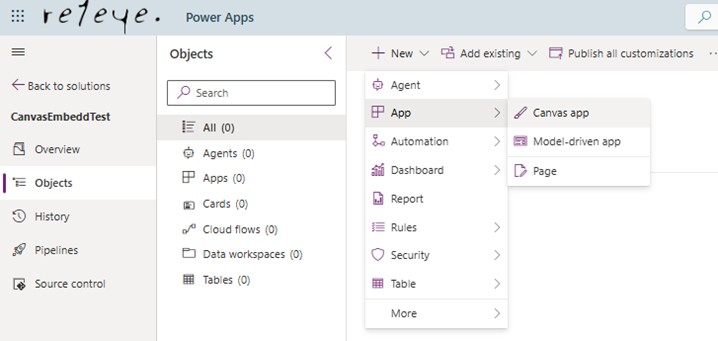
Step 2: Save the Canvas App's logical name and App ID
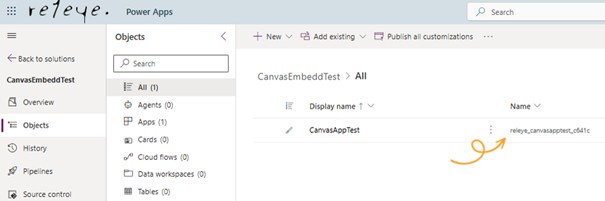
Once the Canvas App has been saved, it will generate a logical solution name and an APP ID. Make a note of these values, as you will need them later.
The logical solution name for the Canvas application can be found within the solution:
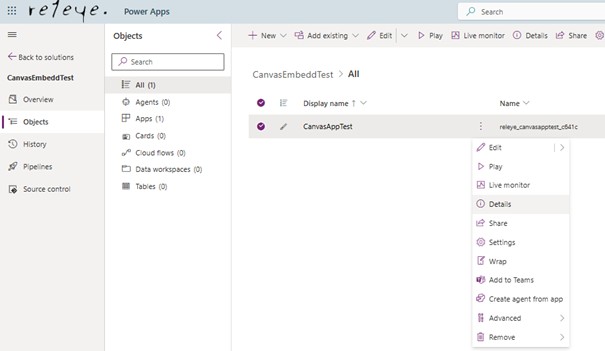
The App ID (App GUID) is also available within the solution, under the Canvas App “Details”:
Step 3: Open the relevant form in Classic Designer
Now it's time to embed the Canvas App into a Model-Driven form. To do this, open the form where you want to embed the Canvas App using the classic designer.
Step 4: Add an Option-set field and a PCF control
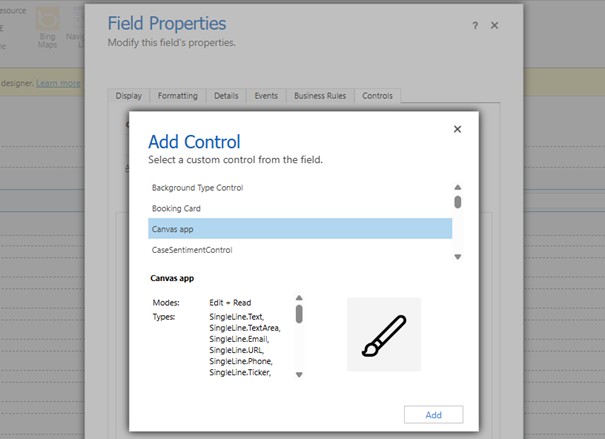
Create a tab and/or section where the Canvas App should be placed on the form. In the new section, add any unused Option-set field. If there are no unused Option-set fields available, you can create a new one in the table for this purpose.
Double-click the added Option Set field to open the “Field Properties” and navigate to the last tab labeled “Controls.” Add the “Canvas app” control, which will only be available if the field is an Option Set.
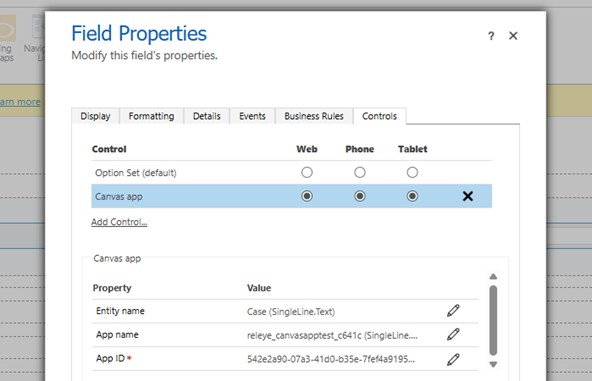
In the “Property” section, update the “App name” and the “App ID” with the strings you saved earlier (step 2) by using “Bind to static values”.
Step 4: Save & Publish – Form & Canvas App
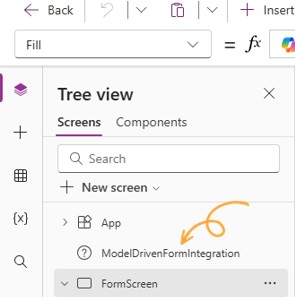
Once the form is saved and all changes are published (including the Canvas App), the Canvas App should now be successfully embedded in the form. If everything is done correctly, a new integration property named “ModelDrivenFormIntegration” should be automatically created within the Canvas App. This integration property enables the Canvas App to use the content of the record from which it is run on the form. This integration component cannot be added to a Canvas App manually.
Step 5: Finalize the Canvas App with form integration features
Now that all the prerequisites have been met, the Canvas App can be finalized using Model-Driven Form Integrations. This form integration allows the Canvas App to retrieve information from the record of the form from which it is run. Continue reading below for relevant use cases where this feature is used to drive specific finance and banking processes.
Use Case 1: Know Your Customer (KYC)
A bank onboards private customers through a regulated KYC process.
KYC is part of a broader customer onboarding process, managed from the Case table using cases of theOnboarding type.
Onboarding agents need:
- A fixed, guided interface during customer calls
- Automatic storage of responses in Case and Account
- Full traceability for compliance and audit purposes
All responses are stored in structured Dataverse fields, ensuring:
- Auditability
- Reporting readiness
- Regulatory compliance
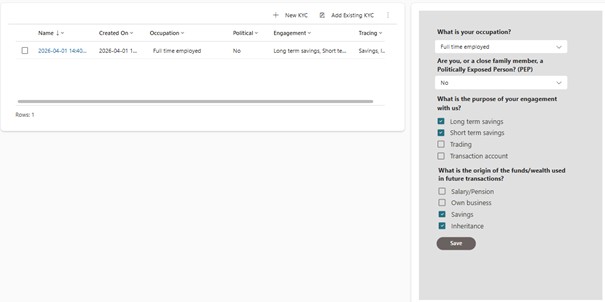
The embedded Canvas App is displayed in a new tab on the Case form. The options available in dropdown menus and checkboxes are dynamically retrieved from a Dataverse table named KYC. Once the user completes the inputs and clicks Save, a KYC record is created and linked to both the Case and the associated Account. The form refreshes automatically, and the newly created record is immediately displayed in an adjacent sub-grid with a timestamp. All responses are stored in structured Dataverse fields and can be used for reporting and follow-up.
Use Case 2: Credit Check
As part of the onboarding process for new customers at a bank, customers must meet a minimum credit score.
Credit scores are retrieved from a third-party integration using the customer’s Social Security Number. The integration returns the credit score, and for customers who do not qualify, the onboarding case must be automatically deactivated.
Solution Architecture
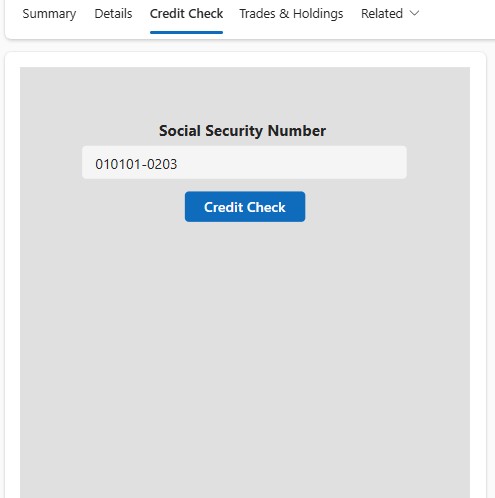
- This embedded Canvas app is displayed in a new tab on the Case form, following the instructions provided earlier.
- The Social Security Number field is automatically populated based on the account's SSN.
- When a user clicks the “Credit Check” button:
- The Social Security Number is sent to an external provider for credit scoring
- The credit score is assessed
- The UI responds dynamically:
- ✅ Qualified
- ❌ Not Qualified
If the customer does not meet the requirements:
- The onboarding case is automatically deactivated
- No manual follow-up or risk of process deviation
This ensures consistent enforcement of business rules and reduces operational risk.

Why Releye?
At Releye, we help banks and financial institutions tailor Microsoft Dynamics 365 to their actual business needs—striking a balance between compliance, efficiency, and user experience.
From onboarding to case management, we design solutions that simplify complex processes such as KYC and credit checks.
Curious how this could work in your organization?
Get in touch with us to continue the conversation.
Contact us today
Email us at info@releye.se