

Customer service is shifting from menu-driven options in phone queues to "natural" conversations with AI
Customer service is moving away from rigid menu-based systems and toward a model where systems can better understand the customer’s goals. This is an interesting development, but it’s also a shift that raises questions beyond just technology. As more tasks become automated, there will be a need to coordinate roles, staffing, and the future of traditional call center duties.
The trend points toward a combination of AI agents, IVR (interactive voice response), and traditional human customer service, rather than a scenario where everything is replaced in the coming years. Perhaps this is also where the strategy needs to focus first and foremost right now: how to build a customer service system where AI can handle certain tasks, where guided flows still play a role, and where the customer can always be connected to a human representative when needed.
From button-based navigation to more natural conversations
For a long time, the phone channel has primarily been designed to sort customers. People have navigated through menu options, said a few keywords, and then been routed through a predefined flow. It has worked, but it has also been relatively limiting and, in our experience, has often caused frustration when, after several attempts, the customer still hasn’t reached the right department. The customer has often had to adapt to the system’s logic, rather than the other way around.
A feature that began rolling out in April in Contact Center (Dynamics) allows the phone system to better understand customer inquiries, ask follow-up questions, retrieve information from back-end systems, and transfer the case to a human agent with the full context intact.
This is a significant shift—not only from a technical standpoint, but also in terms of how we need to approach customer service moving forward. As conversations become more natural, customer expectations also evolve. It’s no longer enough for the technology to simply work; it must also feel relevant, seamless, and intuitive in the moment.
The new approach isn’t really about making old phone menus a little smarter. It’s about moving away from the traditional logic where the customer must first choose the right path, and instead letting the customer describe their problem more naturally.
There’s a big difference between saying, “Press 1 for billing, press 2 for shipping”
and be able to address comments such as: “I haven’t received my order, and I also think I’ve been charged incorrectly.”
The latter is more like the way people actually speak.
In the best-case scenario, this type of solution:
- understand what the customer is trying to solve
- ask relevant follow-up questions
- verify information in other systems
- switch languages during a call
- and, if necessary, forward the matter to customer service with the appropriate context
The handoff itself is crucial. One of the most common sources of frustration in customer service is when a customer has to start over once their case is handed off to a human agent. If AI first takes over the case and then hands it off with a summary and background information, the experience is significantly improved.
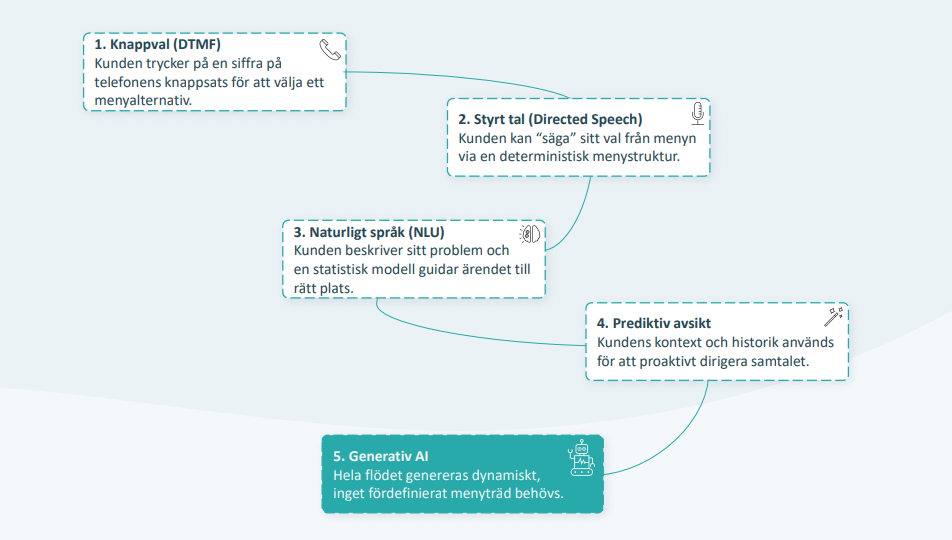
Timeline – From IVR to Generative AI in Contact Centers
But there is also an uncomfortable side to this development
This development is not portrayed as merely positive and straightforward. Because it isn’t. There is one aspect here that many find genuinely challenging: the concern about what will happen to human roles as voice AI becomes better at understanding, sorting, and resolving issues directly.
The truth is more nuanced. Analyses from sources such as Gartner and Microsoft show that while repetitive tasks are decreasing, the demands on human roles are increasing. We are seeing a shift from transactions to relationships—or, more generally, from pure task automation to new forms of interaction between humans and AI.
It’s easy to underestimate how important human interaction still is. Microsoft’s global studies on customer service show that the need for human channels remains as issues become more complex. The same pattern also emerges in more recent studies: customers often accept AI for simpler and more predictable issues, but are more likely to want to speak with a human when the situation is sensitive, unclear, or requires empathy.
Therefore, it is more accurate to speak of a shift in the nature of work rather than a simple transition from humans to technology. When certain tasks are automated, the value of the human contribution also changes. As MIT Sloan Management Review and the Boston Consulting Group describe in a 2025 report, organizations need to redesign work either by adapting existing processes or by reimagining them from the ground up to function in hybrid teams of humans and AI agents. Customer service then becomes not just a matter of resolving issues quickly, but also of when and how human presence makes a difference. This also places higher demands on leadership, as the change is not just about technology but about how roles, responsibilities, and ways of working are shaped around it.
How AI and humans need to work together
To integrate AI with the customer service department rather than pitting them against each other, we need to build a model where they reinforce each other. In other words, the time freed up by AI automation is reinvested directly into customer relationships. It’s about:
- Let AI handle the filtering: Speed, data retrieval, and standard solutions.
- Let the employee take the lead when more is needed: When a case requires empathy or involves a complex exception, the employee steps in with full authority.
- Building personal trust: The employee transitions from being a “case worker” to becoming an “advisor” or “brand ambassador.” This is where good judgment and a personal touch create value that a machine—no matter how naturally it speaks—can never replicate.
What might a combination look like?
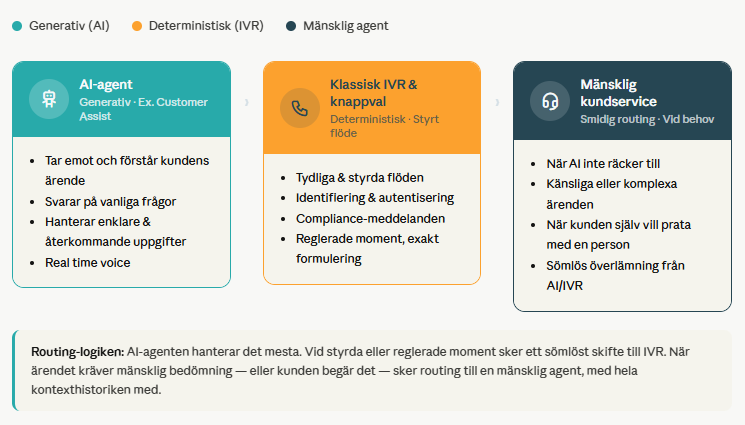
From a practical standpoint, and in terms of the technical setup, it might look something like this:
- AI agents
For example, Customer Assist Agent with real-time voice. It is used to receive inquiries, understand what the customer means, answer common questions, and handle simpler or more routine tasks.
- Classic IVR and menu navigation
For those areas where clear and controlled workflows are still needed—such as identification, certain elections, compliance notices, or regulated processes where precise wording is important.
- Seamless routing to live customer service
When AI isn't enough, when the matter is sensitive, or when the customer prefers to speak with a person.
It is precisely this combination that we find most realistic. Not a complete abandonment of old ways of working, nor a future where everything is handled by AI. Rather, a customer service model where different levels of service work together more effectively than they do today.
What Companies Need to Prioritize in 2026
The key point isn’t just that AI can respond faster or sound more natural. What’s interesting is that call centers are shifting from being a sorting hub to becoming an integral part of the problem-solving process itself. This requires a rethink of staffing, skills, process design, knowledge transfer, and the customer experience.
This also means that the role of customer service representatives becomes more specialized. Less time needs to be spent on tasks that don’t really add much value in and of themselves, such as repeating information, reviewing previous notes, or entering the same data in multiple steps. Instead, more time can be devoted to tasks that require judgment, responsibility, and human interaction.
But this won’t happen on its own. For this transition to work in practice, it’s not enough to simply purchase new software. We also need to consider how work should be organized around it, what expectations should be set for different roles, and how the transition between automation and human processing should work without creating new friction.
Perhaps that is where the change lies—not just in systems becoming smarter, but in the fact that customer service needs to be redesigned based on what technology actually makes possible. Companies need to be quite honest with themselves here. It’s not enough to ask what technology can do. The more important question is where it actually creates value, and where it risks making the customer experience worse.
Some questions worth considering:
- Where in our customer service department do current work practices create the most unnecessary friction?
- What types of tasks are actually suitable for an AI agent?
- Where is human intervention needed right from the start?
- Which components require ongoing management and are therefore better suited to traditional IVR?
- How do we ensure that customers can always speak to a live person when needed?
- Do we have the knowledge, infrastructure, and data quality needed for AI to actually work well in practice?
- Are our employees prepared to take on more specialized roles as the number of simpler tasks decreases?
It is only when this balance is achieved that AI becomes strategic. Otherwise, AI risks becoming just another layer of technology piled on top of old ways of working. The question moving forward is therefore not whether AI should be integrated into customer service, but how the interaction between AI, management, and human contact should be designed so that it actually works for the customer.
Sources and further reading
Microsoft (2026): Dynamics 365 Contact Center AI agents
Gartner (2026): Gartner Survey Finds That 85% of Service and Support Leaders Are Expanding the Responsibilities of Human Agents.
MIT Sloan Management Review (2026): How to Navigate the Age of Agentic AI.
Microsoft (2020): Global State of Customer Service
Harvard Business Review (2026): In an Automated World, Human Hospitality Is a Competitive Advantage.
Please feel free to contact us at Releye to discuss your challenges and what it will take to address them.
Contact us today
Email us at info@releye.se